“America Isn’t Dying—Beijing Just Wants You to Think It Is: Dissecting China’s Information War on U.S. Decline”
Creator: Gao Xiaowen | IPI Global Observatory
Recently, The South China Morning Post posted an article titled: “America Isn’t Dying—Beijing Just Wants You to Think It Is: Dissecting China’s Information War on U.S. Decline.” This provocative title comes from the fact that Chinese state media is portraying America as a “failed state,” and that Beijing is making preparations to overtake Washington. However, the analysis of the US is shallow and reveals part of Beijing’s strategy to undermine American audiences while at the same time strengthen resolve among Chinese nationalist.
The article mentions Beijings economic plan from 2026 to 2030, while a major component to the article, the claims are bold:
Tuesday's commentary sought to highlight the situation in the United States, saying that "political polarisation is intensifying ... and domestic governance is increasingly strained" in the country."Where is the dignity of a major power? For decades, the US maintained its glossy image through global hegemony, but now it has entered a downward spiral of decline," it said.
"The halo was always an illusion, and the myth was fragile. To borrow Trump's own words: America has, in many ways, become a failed state, it is 'dying from within'."
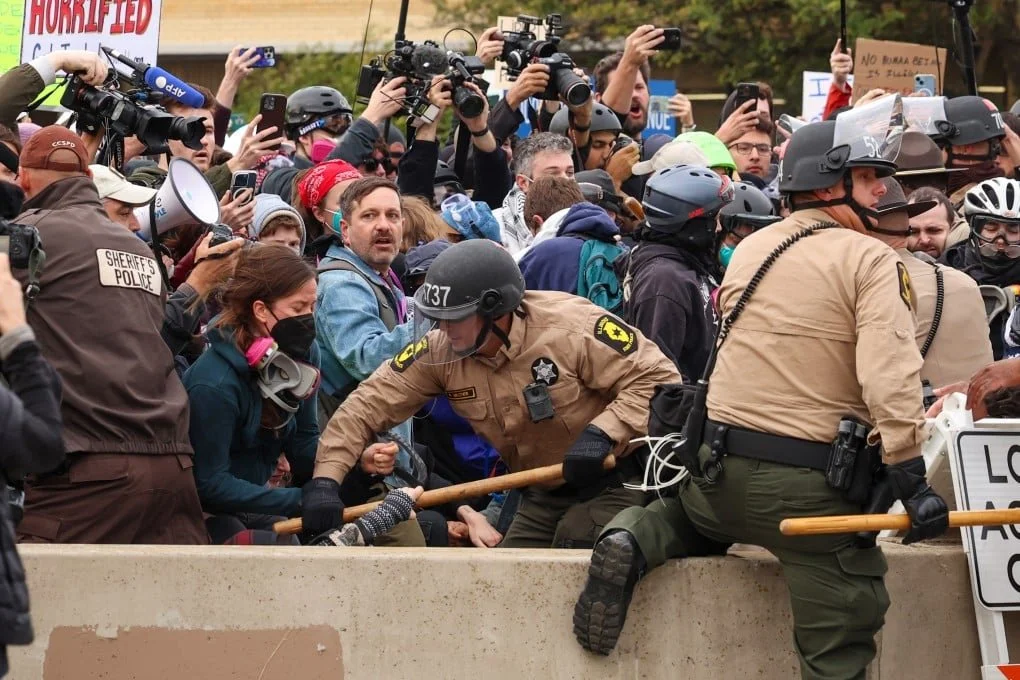
Protestors clash with police | South China Morning Post
These claims are backed up by the evidence of large-scale protests around the country, the US government federal shutdown, and President Trump’s Tariff measures, which say that it will backfire on ordinary Americans.” Why make these claims to begin with? These accusations do not take into account American culture and government. A significant detail that the American founding fathers had when creating the United States was the idea of checks and balances. While it is unknown to most, factionalism stands as one of these checks and balances to ensure that not one political party can have complete control over the country. Throughout American history, there has always been division. In the beginning, the conflict stemmed from Loyalists vs Patriots, about creating a new country or reconciling with the British Crown. Following the American Revolution, Federalists vs Anti-Federalist argued about how strong the American government should be. Then, after Republicans and Democrats now fight on social and political issues. Political unity is not a symbol of a strong democracy, but an illusion of authoritarian governments, which have to resort to censorship at the end of brute force.
This article and initial posts might be geared towards Western audiences, but the language and tone suggest that it is intended for domestic Chinese audiences to show that Beijing is going to rise from its economic troubles and that America is falling apart. Beijing Youth Daily noted that the Los Angeles protests against President' Trump’s immigration policies were proof of a broken government and a lack of social cohesion in the country. This analytical flaw is a projection of Chinese culture on American society. In comparison to American history, China has a rich and beautiful history composed of a dynastic cycle of rise and fall. Where most often, scholars point to a lack of “cohesion.” A well-written article titled: Party Leadership and Rule of Law in the Xi Jingping Era, written by Jamie P. Horsely noted that the Chinese Communist Party does advocate for freedom of speech but:
“The coexistence of that “normal” state with the party’s “exceptional” state, fostering a conditional attitude
toward how law is applied, is what is particularly problematic. No standards for determining when one
crosses the line to become the “enemy” are publicly available. No process seems to exist to guarantee
access for such “enemies” to independent counsel to help challenge, or to an independent body to
review, the determination that places one outside the protection of the law.”
Chinese state media makes bold claims to raise morale amoung it’s domestic audiences and demoralize Western audiences. While the United States faces issues, standard protests and disagreements are the heart of a democratic society. The white paper protest that broke out during objections to Xi Jingping’s restrictive Zero-Covid policy, is a testament to the issues the Chinese Communist Party faces. Regardless of censorship or harsh laws, the average Chinese dissident will find ways to express their grievances. These protestors held up blank pieces of paper in silence to avoid sever punishments in creating disorder to “social harmony,” in fact the slang for censorship in China is harmonization. This is a direct “jab” towards egregious human rights violations restricting freedom of speech in China.
Chinese state media attempts to paint America as a strong empire that is weakening and crumbling under pressure. This depiction of America as an Empire, is devoid of the fact that the United States holds enormous political power through its strong alliances throughout the world. In most modern conflicts, the United States constantly works with allied partners, militia and in rare cases adversaries. From the Iraq invasion involving a coalition of nations, to even small engagements that saw the United States work together with North Korea to stop the Dai Hong Dan from Somali pirates. The goal is to project China’s inevitable rise as a superpower, that it will overtake the United States, however Beijing’s recent attempts at power projection past its own borders continues to suffer setbacks such as the Belt and Road initiative. By strengthening internal resolve, and rallying it’s citizens, Beijing hopes to capitalize on it’s population to fight a common enemy and avoid social disharmony. In addition, China seeks to demoralize Americans by consistent bombardment of information via social media or online articles, that America is on the decline.
This recent article from the South China Morning Post, is one of several ways foreign adversaries attempt to influence Americans and western audiences. By creating a false comparison, audiences are disillusioned to believe that the West is failing and that (in this example) China is on the rise. This brilliant strategy targets domestic and foreign audiences. To combat information warfare is a struggle, since disinformation can be produced faster than the truth. Beijing’s narrative of American decline is less prophecy than projection, an echo of it’s own fears about cohesion, control, and the fragility of power.”
